

近日,上海应用技术大学团队联合上海交通大学、美国罗格斯大学等单位在《Food Chemistry: X》发表研究,系统探究了甜橙中九种甜香化合物对5%蔗糖溶液的甜味增强效应及其机制。通过静态感官评价和电子舌分析发现,香芹醇的增甜效果最为显著(28.8%),其次为γ-癸内酯(23.2%)、γ-壬内酯(23.0%)和δ-癸内酯(20.0%)。采用时间-强度法进行动态感官评价表明,添加甜香化合物后甜味感知快速上升且持续时间略有延长。分子对接显示,T1R2/T1R3-蔗糖复合物的结合自由能为-5.9 kcal/mol,而添加芳香化合物后的三元复合物结合能显著降低(-8.62至-10.5 kcal/mol),表明受体-配体亲和力增强。分子动力学结果表明,芳香化合物的加入导致T1R2/T1R3-蔗糖体系结合能降低,氢键和疏水相互作用增强,蛋白质构象动态变化趋于稳定。该研究为通过香气调控实现减糖不减甜的食品配方设计提供了理论依据。
研究背景
柑橘类水果因其丰富的品种和巨大的产量,在全球农业和食品工业中占据重要地位。其风味,尤其是甜橙的独特风味,因其丰富的营养价值和广泛的应用潜力而在食品工业中备受青睐。在风味化合物的提取、稳定性维持和新场景开发方面亟需实现创新突破。
柠檬烯是本研究中的主要香气化合物之一,被确定为甜橙皮中的主要挥发性物质之一。它不仅通过其贡献形成橙子的特征甜果香,还被推测能引发愉悦和放松等积极情绪反应。它不仅能增强食品的可口性,还能通过跨模态协同效应显著减少糖的消耗。此外,采用分子动力学模拟技术揭示了香气化合物与甜味受体之间的动态结合过程。这种动态分析解决了传统静态感官评价的局限性,为开发新型降糖策略奠定了理论基础。
通过整合感官评价、电子舌技术和分子模拟,建立了多维研究体系。此外,揭示了甜橙香气化合物通过甜味受体T1R2/T1R3的变构调节增强甜味的机制。传统感官评价缺乏动态分析和客观验证,因为静态评估往往无法复制真实应用场景。相比之下,动态感官评价更好地再现了自然状态下的人类感官体验。电子舌技术通过仿生传感器阵列实现甜味和酸味的实时电信号转换。例如,它已应用于葡萄酒质量控制,并进一步用于分析苹果的鲜味差异,为跨模态研究提供定量数据。风味感知的机制研究在很大程度上依赖于分子模拟技术。
研究内容
本研究考察了甜橙中九种香气化合物对味觉感知的影响。首先,通过人体感官分析和电子舌测量评估了它们在5%蔗糖溶液中的甜味增强效果和适口性调节作用。其次,利用分子对接确定了结合亲和力和相互作用力。第三,对T1R2/T1R3-甜香-蔗糖三元体系进行了分子动力学模拟,以表征动态结合过程。本研究揭示了甜香化合物增强甜味感知的机制,为开发更健康且美味的减糖食品提供了基础见解。
研究结果
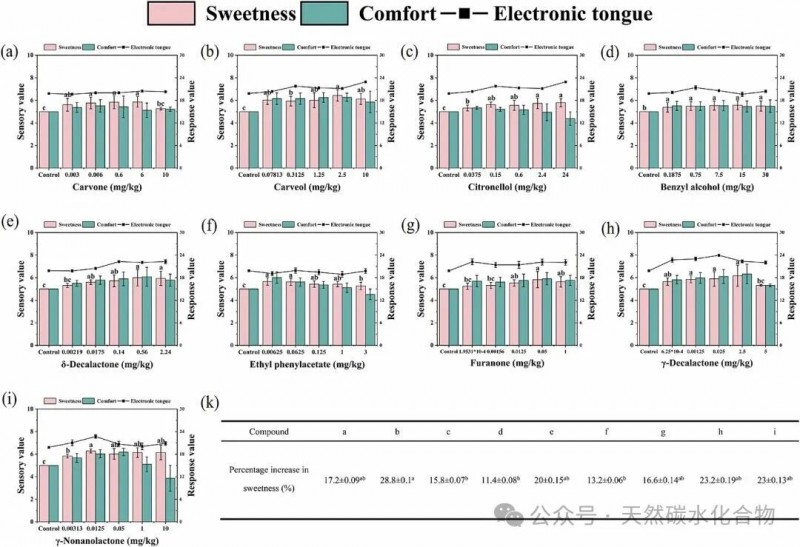
Figure 1. a-i: Electronic tongue response, sweetness value, sensory evaluation and comfort levels of sweet aroma compounds in 5% sucrose. Error bars indicate the standard error of the mean. Pink bars suggest sensory sweetness at each aroma concentration; blue bars denote sensory comfort at each aroma concentration. (a) carvone, (b) carveol, (c) citronellol, (d) benzyl alcohol, (e) δ-decalactone, (f) ethyl phenylacetate, (g) furanone, (h) γ-decalactone, (i) γ-nonalactone, (k) the percentage increase in sweetness of nine sweet aroma. Different lowercase letters in the figure indicate significant differences in sweetness scores among different concentrations of the same compound (Duncan's multiple range test, p < 0.05). The blank control was a 5% sucrose solution, and its sweetness value was set to 5. (For interpretation of the references to colour in this figure legend, the reader is referred to the web version of this article.)
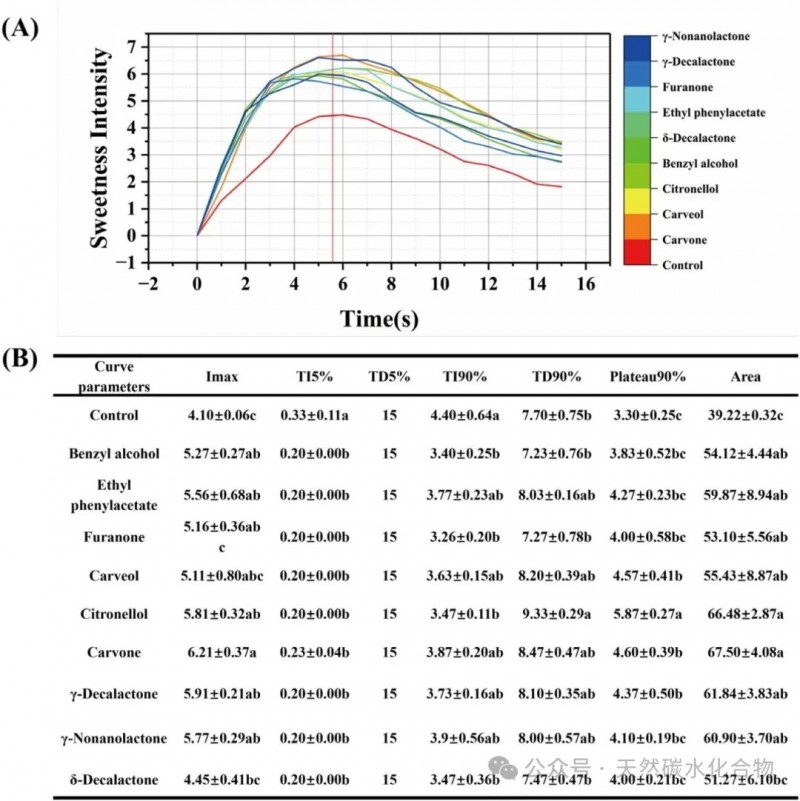
Figure 2. (A) Presets average sensory TI curves of nine sweet aroma compounds in a 5% sucrose solution, the red control (a 5% sucrose solution) acts as the blank for the others. (B) Shows characteristic values of the curves, Imax is the maximum intensity corresponding to the peak of the curve, T15% is the time to reach 5% intensity, TD5% is the decay time for 5%, T190% is the time to reach 90% intensity, TD90% is the decay time for 90%, Plateau90% is the duration for which the sweetness remains at 90% of the maximum intensity, Area is the area under the curve (AUC). (For interpretation of the references to colour in this figure legend, the reader is referred to the web version of this article.)
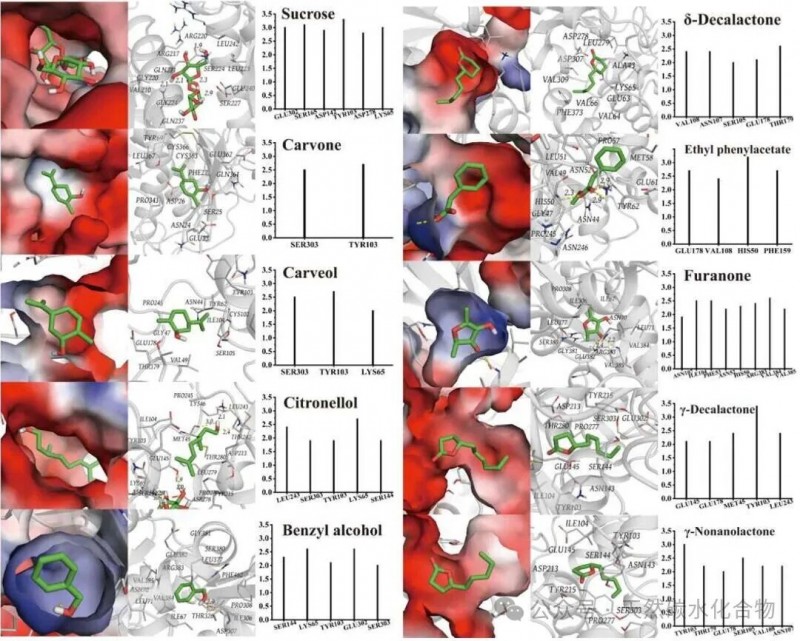
Figure 3. Electrostatic potential maps of nine sweet aroma compounds and sucrose alone, 3D diagrams, and the hydrogen bond distances between key amino acids of T1R2/T1R3-sweet aroma compounds-sucrose.
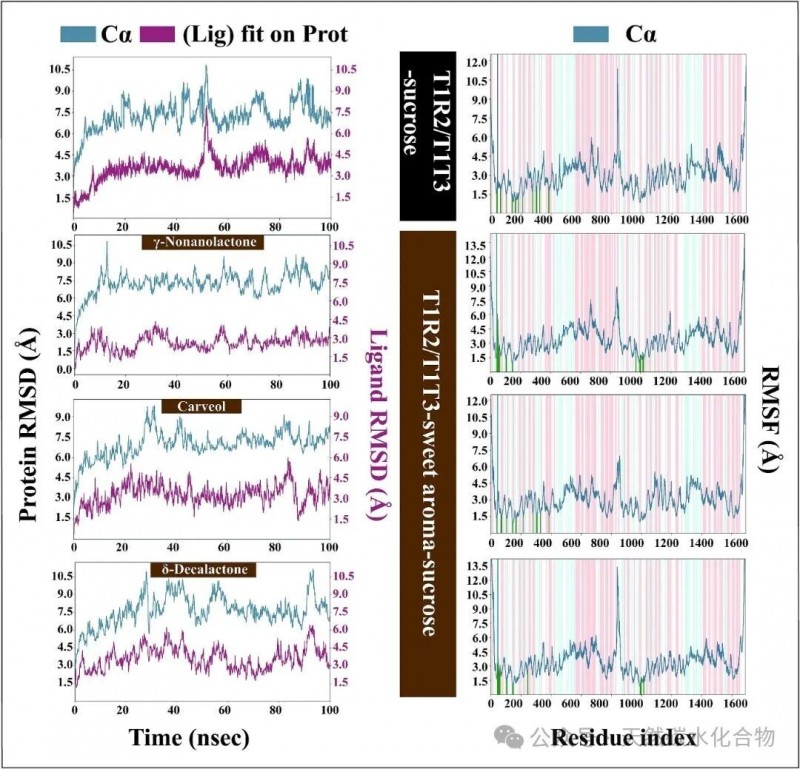
Figure 4. The RMSD and RMSF in the ternary systems of T1R2/T1R3 with sucrose after the addition of γ-nonalactone, carveol, and δ-decalactone were respectively demonstrated.
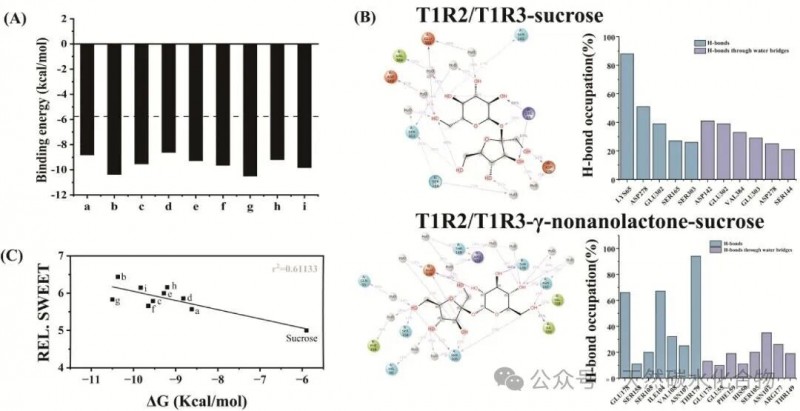
Figure 5. (A) Binding free energy of T1R2/T1R3-sweet aroma compounds-sucrose; (B) shows a schematic diagram of the interaction between ligand compounds and protein residues. The blue column represents the direct formation of H-bonds between ligands and residues, while the purple indicates the indirect formation of H-bonds through water bridges; (C) denotes the comparison and correlation between relative sweetness in the experiment and the binding free energy of T1R2/T1R3-sweet aroma compounds-sucrose. (For interpretation of the references to colour in this figure legend, the reader is referred to the web version of this article.)
研究结论
筛选了九种甜味化合物添加到5%蔗糖溶液中的甜味增强效果。通过感官评价和电子舌分析相结合,发现所有化合物在不同程度上增强了蔗糖甜味,同时保持了适口性。其中,香芹醇表现出最显著的甜味增强效果(28.8%,与其他所有化合物相比p < 0.05),其次是γ-癸内酯(23.2%)和γ-壬内酯(23.0%),两者之间无显著差异(p > 0.05),以及δ-癸内酯(20.0%)。对九种甜味化合物与甜味受体T1R2/T1R3进行了分子对接。对接结果显示,在甜味化合物存在下,与蔗糖的结合能降低(从-10.5 kcal/mol到-8.62 kcal/mol),表明复合物稳定性增强和甜味可能增强。最后,采用分子动力学评估了γ-壬内酯、香芹酮和δ-癸内酯对T1R2/T1R3-蔗糖体系的影响。分子动力学模拟(0-100 ns)显示,与二元体系相比,蔗糖结合稳定且早期范德华能量降低。库仑力、范德华力、氢键和疏水相互作用被确定为甜味增强的主要驱动力。
来源:公众号-天然碳水化合物
原文链接:https://mp.weixin.qq.com/s/aSvNznyCICni54fAyqHSFw


